
Tom HaberstrohContributing writerThu, April 23, 2026 at 3:55 PM UTC·10 min readChris Nowinski ducked out during a break of a high-level meeting with NFL players and executives so he could talk about Victor Wembanyama.
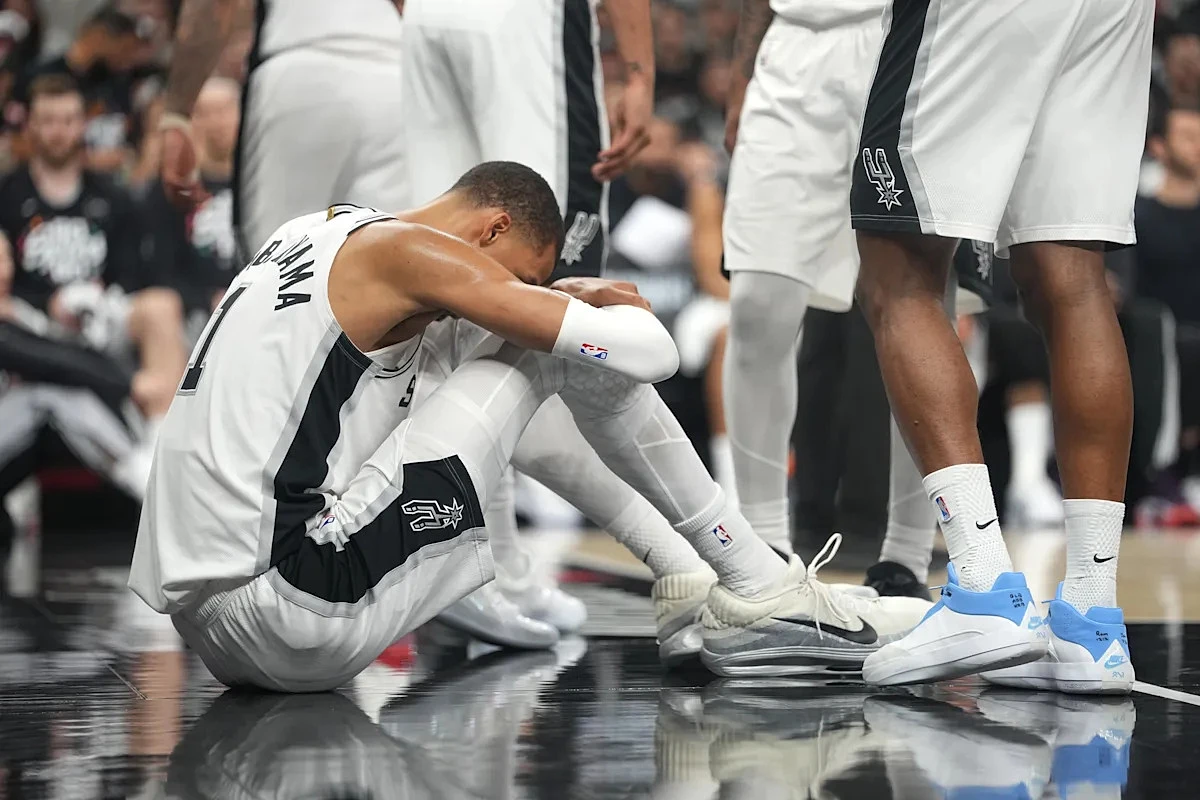
The night before, the founding CEO of the Concussion & CTE Foundation saw the 7-foot-4 San Antonio center’s chin slam into the hardwood in Game 2 of the Western Conference first round. Wembanyama left the game and did not return.
“It was an ugly concussion,” Nowinski said of Wembanyama’s injury. “It was a tough fall. His head bounced off the court aggressively.”
Nowinski was working with the NFL Players Association at the annual Mackey-White Health and Safety meetings. He noted that an NBA players union rep was in attendance as well.
As a neuroscientist who has been a leading advocate for brain safety, Nowinski was pleased to see one thing: Wembanyama got up and left straight to the locker room. There have been countless times that Nowinski, a former Harvard football player and WWE wrestler, has seen players try to force their way back onto the floor against better judgment or medical advice. Wembanyama had the instinct to go in the back and get checked out by docs. He was soon ruled out of the game.
Though Wembanyama made the right call to go straight to the back room, there were worrisome signs of neurological impairment.
“The first thing is, he was slow to get up,” Nowinski said. “It was hard to tell if he was unconscious or not. There was a brief period of time he didn’t move, but he was clearly not feeling right. And I noticed he lost his balance when he first moved, which is another sign of a concussion, and a suggestion that this was a pretty serious injury.”
The question on everyone’s mind should be about the well-being of the superstar 22-year-old. For many NBA fans, they simply want to know when he’ll be back on the floor. In time for Game 3 on Friday? At all in the series? The Spurs are 1-1 in the series against the Portland Trail Blazers with Wembanyama’s status in the air. San Antonio did win the season-series against Portland without Wemby in uniform in any of the three games.
Late Wednesday afternoon, ESPN’s Shams Charania reported that Wembanyama is hopeful to travel to Portland for Game 3, but the Defensive Player of the Year still must pass a series of tests in order to play.
The NBA concussion protocol mandates that a player cannot return to full participation for at least 48 hours after the time of injury and also must complete and pass certain cognitive tests. Game 3 in Portland will take place on Friday night at 10:30 p.m. ET, which will be approximately 74 hours after the injury on Tuesday night. Given that window, Wembanyama could feasibly return in time for Game 3.
Nowinski cautions about rushing him back too soon. According to Nowinski, the 48-hour window isn’t necessarily a well-known marker in the latest neurological science, but rather more of a cautionary reflection of the NBA’s typical “every-other-day” game schedule. For example, the NFL doesn’t have a set time span in its revamped policy; instead, the league instituted a five-step return-to-play protocol that every concussed athlete must pass.
“NBA players often return to full participation faster than we see, for example, in the NFL,” Nowinski said. “That’s in part because most NFL games are a week apart, and so they have a more gradual return to play. The league protocols are designed to fit the game schedule rather than necessarily what we think about in terms of managing long-term risks.”
The NBA’s mandatory two-day sidelining can be beneficial to dissuade teams from bringing a concussed player back in time for the second night of a back-to-back or a game following a day off. In this Wembanyama case, there are two days off between games.
But it’s important to reiterate that, while there is a 48-hour rest protocol, there isn’t anything magical that happens in the brain 49 hours after a brain injury compared to the 47-hour mark. Neither the MLB or NFL have anything in their policy that suggests there’s a two-day neurological process that makes an athlete’s brain healthier after that time.
Putting in a mandated no-go zone can in many cases prevent further injury, but determining when a player is fully recovered from a concussion isn’t as straightforward as it may seem. The symptoms also may not appear right away.
For example, in the 2015 NBA Western Conference finals, Klay Thompson took an inadvertent knee to the head in Game 5 and writhed in visible pain on the hardwood. His ear could be seen bleeding from the trauma, but in the immediate aftermath, the team said he did not exhibit the typical signs of a concussion and therefore was not diagnosed with a brain injury. Because the Golden State Warriors were leading by a wide margin, he did not return to the game due to a contusion and ear laceration.
Later that night, however, Thompson became woozy and vomited several times, according to his father, Mychal Thompson, a former NBA player.
"That's what you feel like when you have a concussion,” Mychal Thompson told ESPN. “I had a few of those when I played back in the stone age of the NBA. We used to just play through them. But now the NBA is really careful with them."
In Klay Thompson’s case, he did not miss any games with the concussion because there was a week layoff between the conference finals and Finals. If the Houston Rockets had forced a Game 6, Thompson may not have been cleared. In the Finals, Thompson shot just 30% on 3-pointers and scored 15.8 points per game, his lowest marks in his six Finals trips.
“While [the two-day layoff] is understandable,” Nowinski said, “I don’t know if the NBA has gotten burned yet by having a 48-hour rule. The day will come when someone returned too soon and has a second injury, whether to a brain injury or a lower extremity injury, because their balance was off or reaction time was off, or moving in a way they wouldn’t have moved otherwise.”