

These rankings are meant for dynasty rookie drafts, but I’m not sure there is a change I would make if I were an NFL GM. As it turns out, the receivers who score the most fantasy points are often the best real-life wideouts as well. This is the tightest race for WR1 I have had in recent years, so I’m going to start out with my top three and then break them down together.
I truly believe there isn’t a single correct way to rank this trio. Even as someone who literally does things by the numbers, I ultimately opted for possibly the weakest production profile as my WR1. For reference, this is how their peak seasons compare to each other.
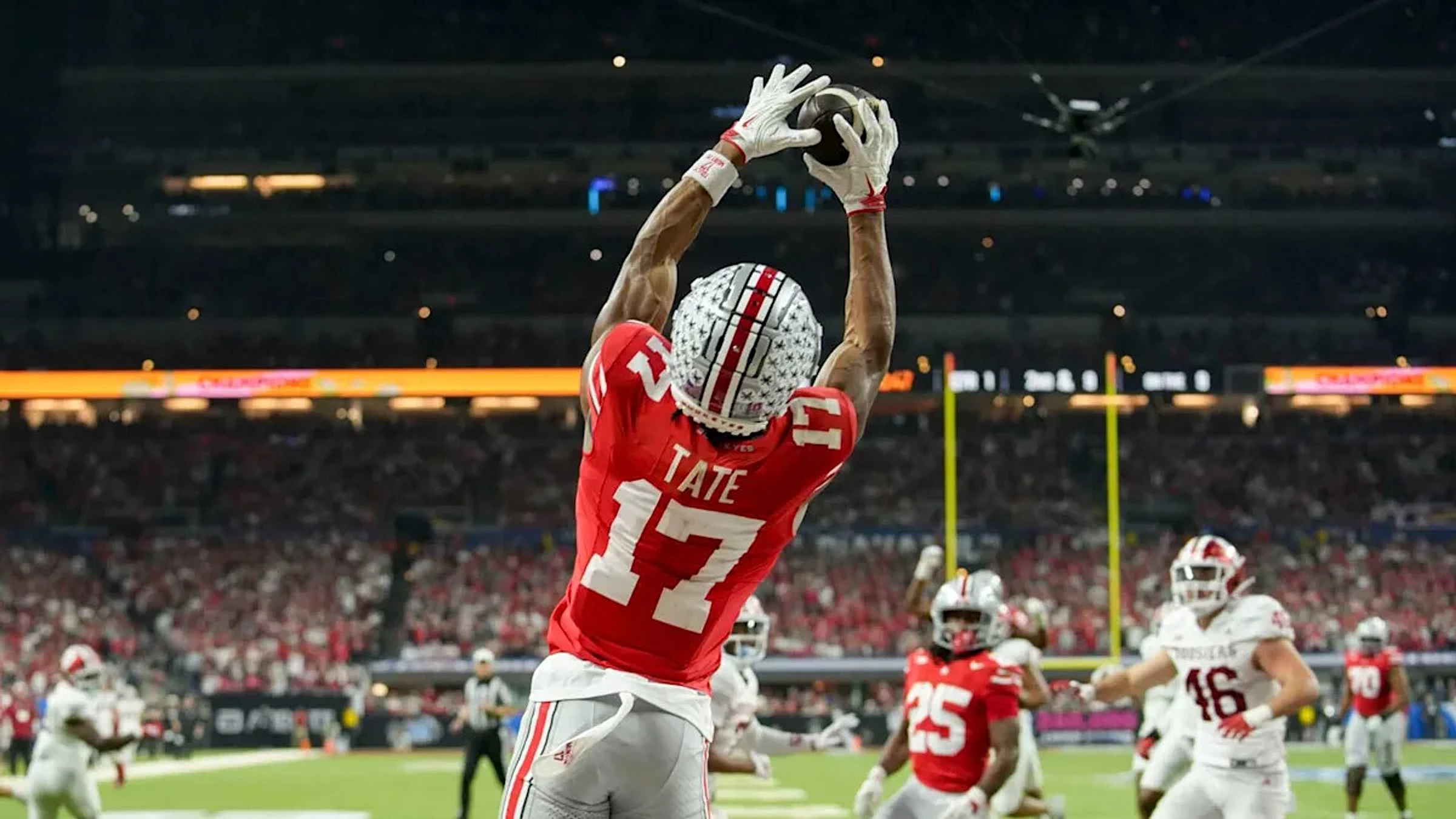
If it isn’t clear, Tate is the old school, outside WR1. He barely played in the slot and earned targets at a lower rate than the other two. As evidenced by his YPRR, Tate more than offset his modest target total by earning those looks farther downfield. More importantly, his target-earning was greatly impacted by Jeremiah Smith. The phenom wideout can already be penciled in as a top-five draft pick in 2027. That level of target competition is extremely rare, and Tate also played behind Emeka Egbuka and Marvin Harrison Jr. early in his career. At 6’3/192, Tate’s 4.5 40-yard dash was almost concerning. Scouts never mentioned an inability to separate though, and the data confirms this. His 19.9 percent career contested target rate is really strong for a player with a 12.9 aDOT. For reference, MHJ had a 24.6 percent contested target rate at an aDOt one yard higher. Tate also brought down 68.8 percent of his contested targets, a mark that dwarfs MHJ’s contested catch rate. This isn’t to say he’s a better prospect than MHJ, only that how Tate wins might translate more seamlessly.
Tyson is somewhere between Tate and Lemon in terms of where he wins. He split his snaps almost evenly between the slot and out wide in 2024, which was his best season. He then moved to the outside for 74.7 percent of his routes in 2025. His YPRR dropped to 2.4, though ASU’s plummeting passing efficiency is largely to blame there. His PFF receiving grade actually jumped to 85.3. A hamstring issue in 2025 also limited him to seven games. The injury lingered into the offseason and he was unable to work out at the NFL Combine or his Pro Day. He suffered multiple torn ligaments in his knee in 2022 that cost him the entire season. Then he missed the end of the 2024 season with a collarbone injury that required surgery. I’m not willing to call him injury-prone, but I bet some NFL teams are.
At his best, Tyson eats man coverage alive with crisp routes and elite short-area speed. He ranked top-five in YPRR and receiving grade against man coverage in 2024. Even in his down 2025 season, Tyson earned a top-10 receiving grade against man. As early as his freshman season, it was easy to see that Tyson was going to be a star. He appeared in nine games and accounted for 29 percent of his team’s receiving yards and 57 percent of their passing touchdowns in those contests. Analytically, this is probably the best profile in the class. I reserve the right to rank him as my WR1 in my post-draft rankings.
The last of the big three receivers in this class, Lemon may be the most projectable. He doesn’t have any injury concerns and he wins where the modern NFL is played: in the short to intermediate portions of the field. He generated 487 yards on targets thrown shorter than 10 yards downfield with a receiving grade of 83.5. Those marks ranked 11th and fifth in the country last year. Lemon isn’t just a slot receiver though. On over 100 routes from a wide alignment, he averaged 3.31 YPRR, the second-highest mark in the country. That was actually a bit ahead of his YPRR from the slot, which was still over three. Lemon also ranked top-five in yards gained on throws 20+ yards downfield. The downside to all of this is that he stands at 5’11/192 and his 6.4 YAC per catch in 2025, while better than the other two receivers I’ve talked about, ranked 91st in the country. Amon-Ra St. Brown is the common pro comparison for Lemon and that would be a great ceiling outcome for him. I see the previous two wideouts with slightly higher ceilings, but there’s a reason I struggled so much in solidifying my top three.
Aside from my first three wideouts, I didn’t break out this article into tiers. Had I done so, Concepcion would be in the second tier by himself. As a true freshman at NC State, Concepcion went for 839 yards and 10 scores. That was good for 33 percent of the team’s passing yards and an absurd 53 percent of their touchdowns. The Wolfpack had no ground game to speak of, so they simply let Concepcion do that too. He ran 41 times for 320 yards, which trailed only NC State’s quarterback. His star came crashing down as a sophomore when NC State’s quarterback, Grayson McCall, only appeared in four games because of concussion issues. Their passing efficiency tanked and with it went Concepcion’s receiving production. With only 459 yards to his name in 2024, Concepcion jumped ship for Texas A&M, where he immediately got back on track. His market share numbers rose and his efficiency hit new highs. He averaged 2.46 yards per route and ranked top-50 in YPRR and PFF receiving grade against man and zone coverage. Those are solid numbers, but his ability to move the chains is uncanny. Concepcion averaged .12 first downs per route run. That ranked 10th in the country among wideouts with at least 200 routes last year.
Concepcion ran 66 percent of his routes from out wide last year, but sitting at just under six feet tall and 200 pounds, he will likely spend more time in the slot in the pros. He was solid out of the slot in 2025, averaging just over two yards per route run, but I hope his future team doesn’t see his size and think of him as a slot-only player. Concepcion also skipped athletic testing and scouts don’t love his top-end speed, so I’m not banking on him being a special athlete. Concepcion has a lot of the green flags that DJ Moore entered the NFL with, and even some of the same red flags.
Boston spent two years parked behind Rome Odunze, Ja’Lynn Polk, and Jalen McMillan before breaking out as a junior with 834 yards and nine scores. The breakout was heavily weighted toward touchdown production as he accounted for nearly half of his team’s passing scores. He upped his share of every counting stat in 2025 with 33 percent of the yards and half of the touchdowns via a 62-881-11 receiving line. Boston wasn’t awfully efficient as a senior, but he boosted his YPRR to 2.44 in 2025, bringing his career average just over two. Arguably the biggest change in his game from 2024 to 2025 was his improved route running. For a 6’4/212 wideout, Boston became incredibly smooth in his routes, leaving corners in the dust far more often in his second season as a starter. His contested target rate went from 22.4 percent to 13.9 percent, but he also improved his contested catch rate from 54.5 percent to a stellar 76.9 percent. Pro Football Focus graded Boston as a top-10 wideout against man and press coverage.
With middling career efficiency and an upperclassman breakout, Boston doesn’t have all of the telltale signs of a future NFL star, but does look like a long-term starter. Michael Pittman is the comparison most scouts lean on, but I see him occupying more of a downfield role in the pros. I compare him closer to Marques Colston or Courtland Sutton.
Cooper redshirted as a freshman and didn’t see much run as a sophomore. He finally made a name for himself in 2024 by leading the Big 10 in yards per reception at 21.2 while scoring seven receiving touchdowns, plus an eighth on the ground. He ran over 90 percent of his routes from out wide and had an aDOT of 16.0. Despite this, he still managed 7.5 YAC per catch. Then, in 2025, he moved almost exclusively into the slot. His aDOT dropped below 10 and he went for 937 yards and 13 scores with another rushing touchdown for good measure. Cooper’s share of the passing game increased to nearly 30 percent and he forced 28 missed tackles, the fourth-most in the country.
Cooper is going to be a first-round receiver from a powerhouse school with a solid and well-rounded profile. What’s not to like? Well, there is one thing. Cooper feasted against weak competition and wasn’t the same player against Power 4 schools. Over the past three years, Cooper averaged 3.79 YPRR and 73.3 yards per game against G5 or FCS opponents. Nearly a quarter of his career receiving yards came against FCS schools and even 75 of his 97 rushing are from a single run against Kennesaw State, a program in their second season in the FBS. Only one of his four 100-yard games came against a Big 10 opponent and he averaged 2.02 YPRR against P4 teams.
Draftniks tend to compare Cooper to Deebo Samuel because of his YAC production and rushing numbers. Samuel averaged more YAC at a far lower career aDOT in college. He also ran for seven touchdowns and scored four kick return TDs. Samuel is one of one. If anything, his former teammate Brandon Aiyuk shares more similarities with Cooper. Both players saw more work on intermediate and deep routes than Samuel while doing less on carries or return duties.
Lance didn’t see much action in his first two years on campus before breaking out in 2024 with 1,054 yards and 17 (you read that correctly) touchdowns at 2.8 YPRR. He caught 24 fewer passes in 2025 but still upped his yardage total by 25 and registered a 35 percent yardage share. He did this by averaging over 21 YPC and at a blistering 3.6 YPRR. Let’s just get this out of the way: He’s Christian Watson. I know the comparison is lazy because they both went to North Dakota State. I don’t care. If you were wondering:
The above numbers are career-long. Both players are outside speedsters who dominated North Dakota State’s limited passing game. Lance was slightly more efficient, though Watson was notably more dynamic with the ball in his hands.
Of course, at the NFL Combine, Lance reached peak Watson.
He logged a near-identical RAS, highlighted by a 4.32 40-yard dash and elite burst metrics. Also like Watson, the three-cone drill was his relative weakness.
Watson has been extremely efficient in the pros, though he has never earned a true No. 1 role in Green Bay. A similar fate likely awaits Lance, which isn’t a bad outcome. If Lance simply finds a team willing to throw more than the Packers, he could be a fantasy WR2 down the line.
Bell “broke out” with 737 yards as a junior, but he accounted for just 21 percent of the Cardinals’ yards at an underwhelming 1.79 YPRR. His senior season was a different story. He made the leap to 2.55 YPRR with a 36 percent yardage share, plus a monster 46 percent touchdown share. Even though his 72-917-6 receiving line doesn't look impressive, it was a step forward in the context of Louisville’s mediocre offense.
At 6’2/222, Bell was designed in a lab to bully cornerbacks, and that’s exactly what he did in 2025. He ranked 35th in the country in YPRR against man coverage (3.25) and finished second in the nation in YPRR versus press coverage (3.18). Bell brought down a respectable 55.9 percent of his contested targets, which comprised 26.5 percent of his overall looks. At his best, Bell seems to be unguardable. From Week 4 to Week 6 of the college football season, Bell totaled 31 catches for 441 yards and five scores, including a monster performance versus the National Champion runner-up Hurricanes.