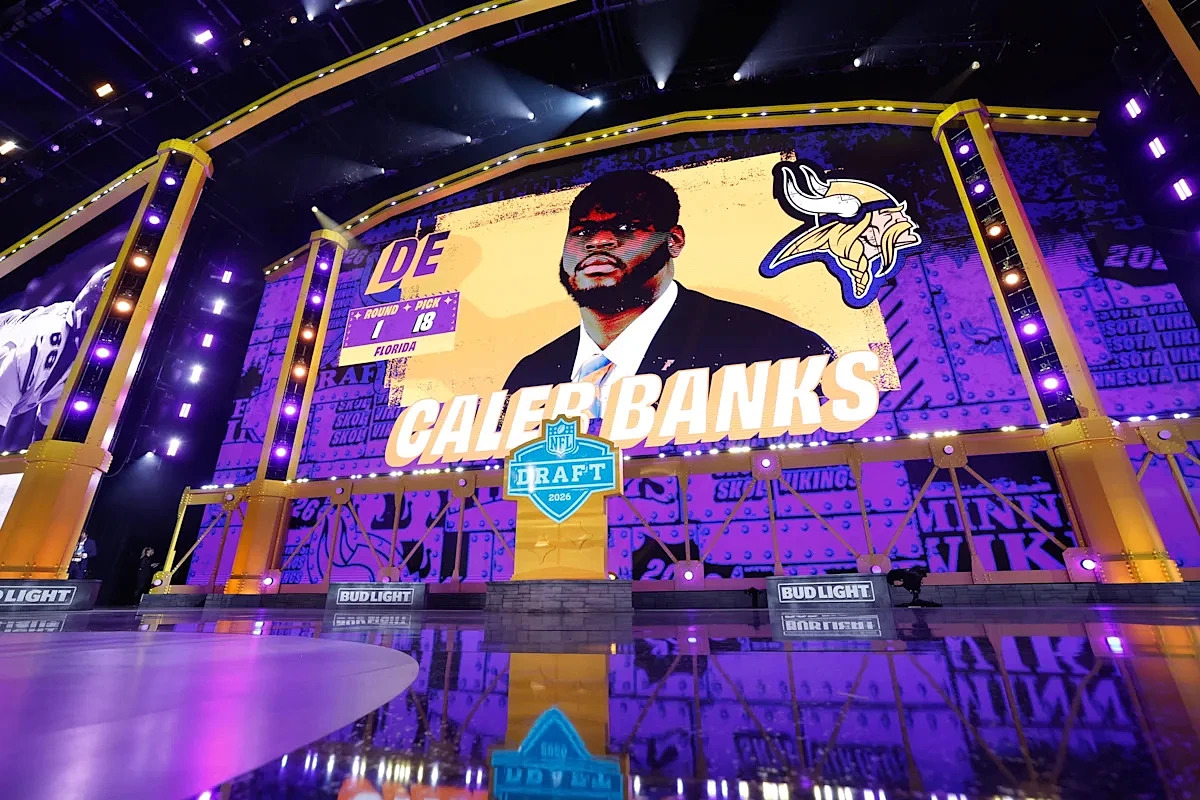


With the 2026 NFL Draft officially behind us, it’s time for all of the Really Smart Football People™ around the internet to draw their final conclusion about how each team’s draft class is going to perform, because these things are always accurate and nobody has ever gotten any of these things wrong in the past.
In all seriousness, drafts can’t really be graded until we’re a few years down the track and we’ve actually seen these young men, you know, set foot on an NFL field and play NFL games and what have you. But, it does give the experts a chance to voice their opinions on how each team did on Draft Weekend, and it does give people something to talk about, so we’ve rounded up a list of everyone’s reaction to how the Minnesota Vikings did over the course of the past three days for your consumption.
Save for the Kyler Murray veteran minimum signing, the Vikings didn’t do a lot in free agency. The biggest changes might have been releasing Javon Hargrave and Jonathan Allen on the interior of the defensive line in cap-saving measures. Jalen Redmond had a six-sack campaign in 2025, but defensive tackle was definitely an issue coming into the draft.
Caleb Banks is a good player. He can wreak havoc on opposing linemen and has legit burst to affect the quarterback in the pocket as an interior pass rusher (4.5 sacks in 2024). He’s at his best as a run stuffer, closing gaps with his 6-foot-6, 327-pound frame, and he brings scheme versatility to the table. But his left foot has been a major problem.
He broke it early last season and was limited to three games. Then he broke it again at the combine, requiring surgery and putting him on the sideline until at least June. That was enough to push him down the Big Board a little bit. I had him ranked 62nd, so taking him at No. 18 was too rich. I was mostly surprised Minnesota passed on safety Dillon Thieneman, but even among the defensive tackles, I had four guys ranked higher, starting with Peter Woods and Kayden McDonald.
Minnesota did take a safety in Jakobe Thomas late in Round 3, and he can create takeaways, with five INTs in 2025. It doubled up on defensive tackle with Domonique Orange and picked up linebacker depth with Jake Golday. But my favorite pick of Day 2 was Caleb Tiernan. I had him ranked 47 spots higher than his draft slot, and he is a massive 6-foot-8, 323-pounder with a ton of experience (44 starts, mostly at left tackle).
The Vikings made four picks on Day 3, and my favorite of the bunch is Charles Demmings. He ran a 4.41 in the 40 at the combine, and with nine interceptions and 35 passes defensed in college, he’s a ball hawk. But overall, Minnesota just didn’t do enough to move the needle.
Needing help on the defensive line, the Vikings took a chance on Banks’ excellent combination of size and agility, despite his injury issues, which reportedly include a broken foot suffered at the combine. Golday has size and athleticism but will need to be a better player than fellow linebacker CJ Allen (taken 53rd overall by the Colts) and safety Emmanuel McNeil-Warren (picked 58th overall by the Browns) to prove he was the best value. Minnesota bolstered its defensive line again in Round 3 with the powerful Orange (aka “Big Citrus”), found a swing tackle in Tiernan and took the physical Thomas over available prospects Kamari Ramsey and Zakee Wheatley.
I love Bredeson going to the Vikings as a potential replacement for valued fullback C.J. Ham, who retired this year, though Bredeson was picked a bit earlier than I thought he’d be, given his injury history and the position’s value. The fifth-rounder received from Philadelphia for quarterback Sam Howell turned into an excellent value in Demmings, who has the size and athleticism to be an NFL starter despite the lower level of competition he faced in college. Claiborne’s the speed back Minnesota needed to boost its running back production; he deserved to be picked at least one round earlier. The Vikings should have added a center and a wideout in this draft, but they waited until Round 7 for Gerhardt and did not select a receiver.
They’re in a weird spot, especially with a substitute teacher in the GM’s chair – which isn’t intended as a shot at Rob Brzezinski. And this draft almost surely will be more productive than ousted predecessor Kwesi Adofo-Mensah’s hauls. Yet first-round DT Caleb Banks might have felt like something of a reach under optimal circumstances, but the broken left foot he suffered at the combine – which is a recurring injury for a very big man – is quite a red flag for a player taken 18th overall. Third-round S Jakobe Thomas could be this year’s most impactful rookie if S Harrison Smith doesn’t return. Yet it feels like Minnesota might not get a ton out of this class in 2026, even as the Vikes vie to get back in the thick of the NFC North race in what might be QB Kyler Murray’s only year in the great white north.
Clearly, the Vikings wanted to improve along the interior defensive line. Banks could have the most upside among the defensive tackles in his class, but the team took a big gamble on a player who has broken his left foot twice in the past year. The Vikings did, however, protect themselves a bit by selecting another interior defender, utilizing extra picks from the Jonathan Greenard trade with the Eagles. Orange offers a lot more than just his cool nickname of “Big Citrus.” Banks is the better pass rusher, but Orange can make an impact in the running game. Minnesota waited until the third round to finally add a safety in Thomas, a ballhawk with five interceptions last year.
Banks: This is a significant reach based on the Consensus Big Board, but the fit in Brian Flores’ defense makes sense. Banks’ length and strength give the Vikings a unique presence on the defensive front that they can move across a variety of alignments, even if his production didn’t stand out at the collegiate level.
Golday: Golday has intriguing length and athleticism with starter potential, but he must improve instincts and anticipation. At worst, he profiles as a strong depth and special teams option.
Orange: Orange is a massive defensive line prospect with elite power potential, supported by impressive weight-room strength. His first-step explosiveness allows him to generate strong speed-to-power as a bull rusher, particularly in attack mode. However, his hand speed and pass-rush finesse are limited, which impacts his ability to disengage consistently. He projects best as a high-effort, power-based lineman in a 3-4 scheme.
Tiernan: Tiernan is a smart, balanced and experienced tackle whose limitations stem from a naturally high pad level and shorter arm length. Despite that, his technique and football IQ give him a path to a starting role.
Thomas: Thomas offers intriguing size and physicality as an enforcer-type safety, but inconsistency likely limits him to a rotational role.
Bredeson: Bredeson’s value is rooted in his blocking ability, highlighted by a career-best 85.2 run-blocking grade in 2025 and strong marks of 78.0 in 2023 and 73.5 in 2024. He has also been reliable in pass protection, earning grades of 87.2 (2022), 73.1 (2023), 68.3 (2024) and 78.1 (2025), while allowing just four pressures and no sacks across 103 career pass-blocking snaps. Receiving production has been minimal, with 12 catches for 132 yards on 17 career targets. At his size, he shows good initial pop and leverage as a lead blocker, though his ability to sustain blocks remains inconsistent.
Demmings: Demmings drew attention at the 2026 NFL Scouting Combine with an explosive athletic profile and strong testing numbers. He measured 6-foot-1 and 194 pounds, which places him in the 68th percentile for height, with 32.13-inch arms in the 81st percentile. He ran a 4.41 40-yard dash (86th percentile) and posted elite explosiveness with a 42-inch vertical (99th percentile) and 11-foot broad jump (96th percentile). He earned a 79.6 PFF grade in 2025 and allowed 18 receptions for 246 yards and one touchdown on 37 targets, while recording four interceptions and six pass breakups, with a 39.8 passer rating allowed. His ball skills and tackling efficiency support sleeper potential, though he will require development at the next level.\
Claiborne: Claiborne is a souped-up, scatback-type runner with a sprinter’s track background that clearly translates to the field. He is at his best in zone-blocking concepts, where his speed and acceleration can stress defenses. He offers solid receiving upside and projects as an RB3 with special-teams value or as a speed complement in a two-back rotation.
One has to wonder if the Vikings are really getting the right amount of value out of this draft having taken two defensive tackles in the first two rounds. (It was the first three rounds, but hey, who’s counting?)