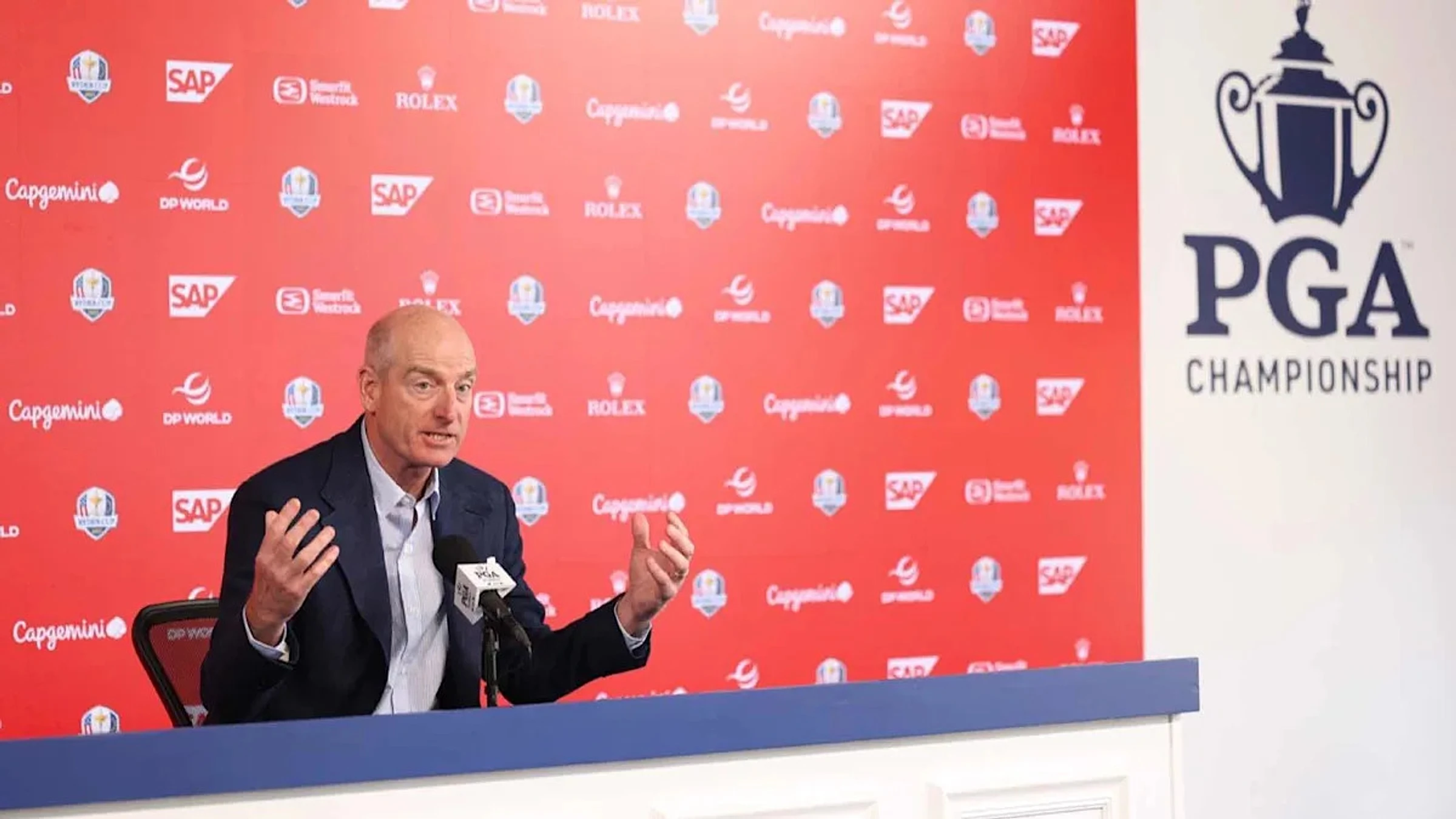
Jim Furyk has been here before, and he knows exactly what went wrong. That, he believes, could be his secret weapon.
Speaking for the first time since being named U.S. Ryder Cup captain for a second time, Furyk addressed the media Wednesday morning at the PGA Championship at Aronimink. His initial appointment drew a cautious reception, largely because he was at the helm during one of America's most crushing Ryder Cup defeats in Paris back in 2018.
But this time around, Furyk sounds like a different leader. His message is sharper, more focused, and refreshingly direct.
"There's not a problem of effort," Furyk stated plainly. "There's an issue of strategy and structure."
That's a significant admission from a captain who once spoke in broad, optimistic terms about a young American core featuring Jordan Spieth, Justin Thomas, and Brooks Koepka. Back then, at the 2017 PGA Championship, Furyk talked about learning from past captains and building on momentum. The reality today is far less rosy.
The U.S. has now dropped two consecutive Ryder Cups, rarely looking competitive in either. The PGA of America's leadership has faced scrutiny, and Furyk's return to the captaincy only underscored a growing concern: American golf lacks a clear, winning blueprint for the biennial event.
Yet, standing at the podium on Wednesday, Furyk offered a level of clarity that was notably absent the first time around. He outlined a series of changes and priorities he hopes to implement as captain of the 2027 squad at Adare Manor. Let's break down the key areas he's targeting.
1. Alternate shot is a major problem
No one who has watched the last few Ryder Cups will be surprised by this one. The Americans have been thoroughly outplayed in foursomes, a format that has repeatedly exposed their lack of chemistry and strategic discipline.
Furyk didn't sugarcoat it. He acknowledged that the U.S. side has been "smoked" in alternate shot, and fixing that will be a top priority. Expect a renewed focus on pairing players with complementary games and building partnerships well in advance of the matches.
2. Structure over star power
In 2018, the U.S. team was loaded with talent but lacked a coherent game plan. Furyk now admits that raw ability alone isn't enough. He's emphasizing a more structured approach to preparation, practice, and in-match decision-making. That means clearer roles for players, more deliberate practice sessions, and a tighter game plan for the unique demands of a road Ryder Cup.
3. Learning from failure
Furyk's greatest asset, he hopes, is the painful lesson of Paris. He's not running from that loss; he's embracing it as a teaching tool. "I've seen what doesn't work," he said, implying that his second stint will be defined by a willingness to adapt, experiment, and discard what failed before.
4. A focus on the road environment
Playing in Europe is notoriously difficult for American teams. The crowd is hostile, the course conditions are unfamiliar, and the pressure is immense. Furyk is already thinking about how to simulate that environment in practice and prepare his players mentally for the challenge of Adare Manor.
5. Building partnerships early
One of the biggest criticisms of recent U.S. teams is that pairings are thrown together at the last minute. Furyk plans to change that by identifying and nurturing partnerships well before the event. That could mean more team events, informal practice rounds, and intentional grouping during majors.
6. Player input will matter more
Furyk emphasized that he wants his players to have a real voice in the process. From course setup to pairings to practice schedules, he's asking for buy-in from the start. That's a shift from the top-down approach that some previous captains have taken.
7. Embracing analytics
The modern game is driven by data, and Furyk is leaning into that. He hinted at using advanced statistics to inform pairings, course strategy, and even practice priorities. It's a nod to the fact that the Europeans have often out-thought the Americans in recent years.
8. A longer runway
With the 2027 event still years away, Furyk has time to build something sustainable. He's not just thinking about one match; he's thinking about a system that can produce winning teams for years to come. That includes working with the PGA of America to improve the pipeline of future captains and players.
9. Culture shift
Perhaps most importantly, Furyk wants to change the culture around the U.S. Ryder Cup team. No more coasting on talent. No more excuses. He's demanding accountability, preparation, and a relentless focus on the details that separate winners from losers in match play.
10. The message is clear: This time will be different
Furyk knows he's being given a second chance, and he's not wasting it. His tone was confident but humble, direct but open. He's not promising a win, but he is promising a team that is better prepared, better organized, and more resilient than the one that stumbled in Paris.
For American golf fans, that's a start. For Furyk, it's the only path forward.