

The Cleveland Cavaliers didn’t get the reputation of being playoff failures overnight. They’ve earned it through years of falling short in the biggest moments.
Although their first-round series with the Toronto Raptors isn’t over by any stretch, Game 4 showed all the telltale signs of what has plagued this team in previous postseason runs: lack of toughness, poor rebounding, the offense falling apart, and an inability to close out tight games.
Cleveland was up eight with just under five minutes to play, but once again couldn’t seal the deal. The offense got stagnant, Donovan Mitchell couldn’t make the one play he needed to, and the defense didn’t stay in front of a Raptors team that was having a historically bad shooting day.
This all culminated in a 93-89 loss. The series now shifts back to Cleveland tied at two.
Mitchell’s lazy eight-second violation in the final minute epitomizes this era of Cavs basketball.
One basket might’ve put the game away, but they couldn’t get the ball over the timeline.
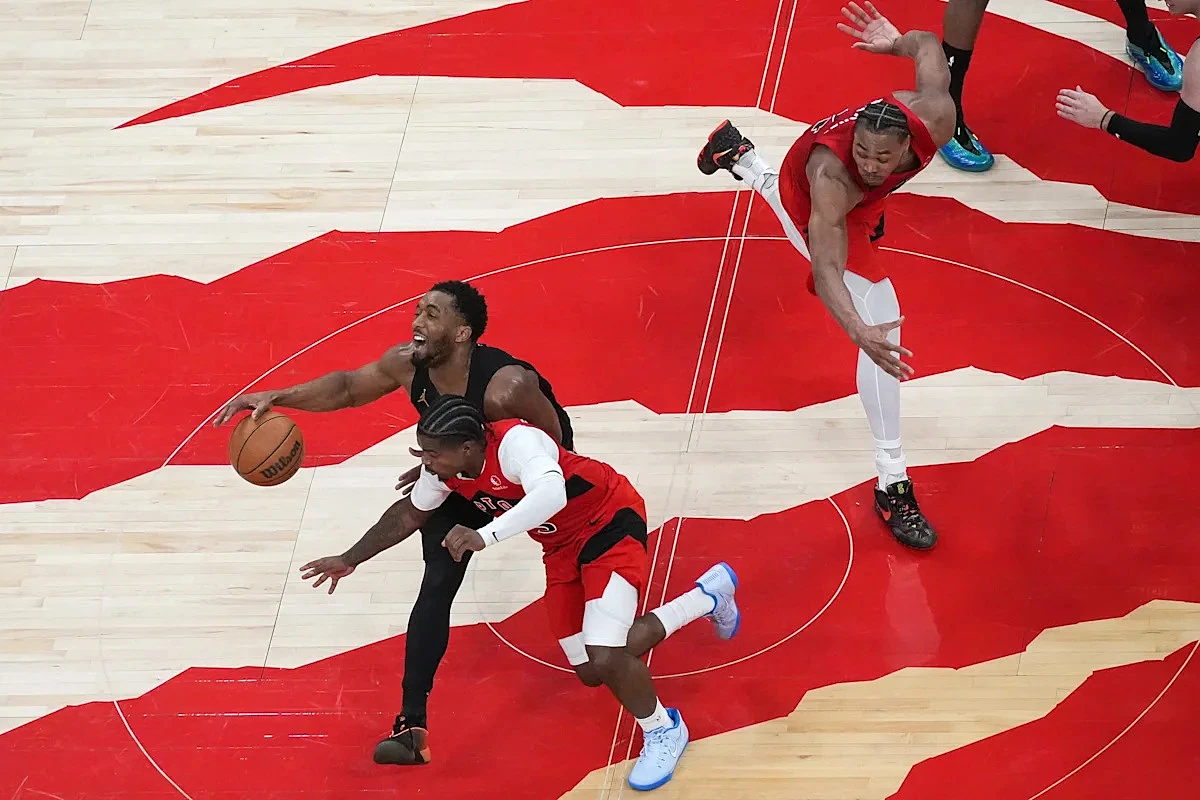
Mitchell didn’t show any urgency at first. He tried to walk the ball up before Scottie Barnes applied token pressure in the backcourt. This wasn’t a trap or anything. James Harden wasn’t being covered; he was leisurely taking his time up the court as well.
Then, Mitchell saw that time was an issue, but he made the mistake of running to the sideline and right into where Harden was aimlessly standing. He had to double back, although at that point, he only had one second to get it over the line.
Jamal Shead sensed the moment. He dove over the half-court line, forced Mitchell back, and poked the ball free. It was a heads-up play from a guy willing to do whatever it took to get the job done.
Shead’s effort isn’t what made this play possible. Instead, it was Cleveland’s lack of focus in the biggest moments — the thing that has come to define this era of basketball.
When we think of this core group, we don’t remember the big playoff wins — because outside of Game 7 against the Orlando Magic (a series the Cavs should’ve won in five) and the Game 2 victory over a sleepwalking Boston Celtics team in ‘24 — there haven’t been any. Just a steady stream of fourth-quarter collapses against teams they’re more talented than on paper.
The Cavs are 4-10 in road playoff games in the Mitchell era. And if you take out two victories over a 37-45 Miami Heat team last season, they’ve only defeated two road playoff opponent that were over .500 despite being in their fourth year together. Just two.
This was Cleveland’s best chance to steal a road game. The Raptors were shooting as if they had Raptor-proportioned arms, going 4-30 (13.3%) from three. This wasn’t the case of the Cavs making incredible contests on these shots. Instead, it was just one of the worst shooting performances you’ll see from an NBA team.
The Cavs — who have been an elite offense since trading for James Harden — couldn’t get anything going. Their star guards couldn’t shake free of Toronto’s bigger wings, and Cleveland’s bigs couldn’t capitalize on the size advantage they did have. This led to a stagnant offense, the same one we’ve seen in the previous three postseason runs for this core.
Mitchell’s teams have consistently lost in the playoffs, but he’s generally scored well in the biggest defeats.
He hasn’t advanced to the conference finals, yet he’s also one of the best playoff scorers in league history. Those two facts would lead you to believe that Mitchell has just been stuck on teams that aren’t talented enough to win or that he’s run into bad luck. There’s been instances of both things being true, but there’s something much bigger at play as well.
The best playoff players can beat teams in a wide variety of ways. No matter how good you are, your opponent will inevitably figure out how to take away what you do best. The ones who can adjust to those adjustments and still impact winning are the most successful. This is why well-rounded players are rewarded more in the playoffs.
Mitchell is well-rounded, but only as a scorer. He’s not a plus defender, isn’t a good playmaker for others considering how much he has the ball, and isn’t disruptive away from the play. This leaves a one-note player whose effectiveness is tied completely and solely to his scoring.
When the scoring isn’t there, as it wasn’t in Game 4 when he went 6-24 from the field, there aren’t many ways he can impact winning outside of just being a decoy for others. But again, that isn’t as impactful as it could be since Mitchell doesn’t do much off-ball.
Can you win with someone like that as your best player? So far in Mitchell’s career, the answer has been no. And if that answer doesn’t change this postseason, is an undersized scoring guard that will be on the wrong side of 30 by the start of next season worth a super-max extension? That’s something the Cavs will have to decide in the summer.